11 Email Metrics Every DTC Founder Should Track in 2026 (Beyond Open Rate)
By Loyal Send, Editorial Team9 min read
Listen to this article10:38
Stop obsessing over open rates. Track these 11 email marketing metrics to attribute real revenue and scale your DTC brand's email channel in 2026.
You're probably tracking open rates like they matter. They don't, not if you're not connecting your emails to actual revenue. Most DTC founders are celebrating vanity metrics while real money leaks out of their funnel.
This list is for founders who want to know which emails pay the bills and which ones are just taking up inbox space.
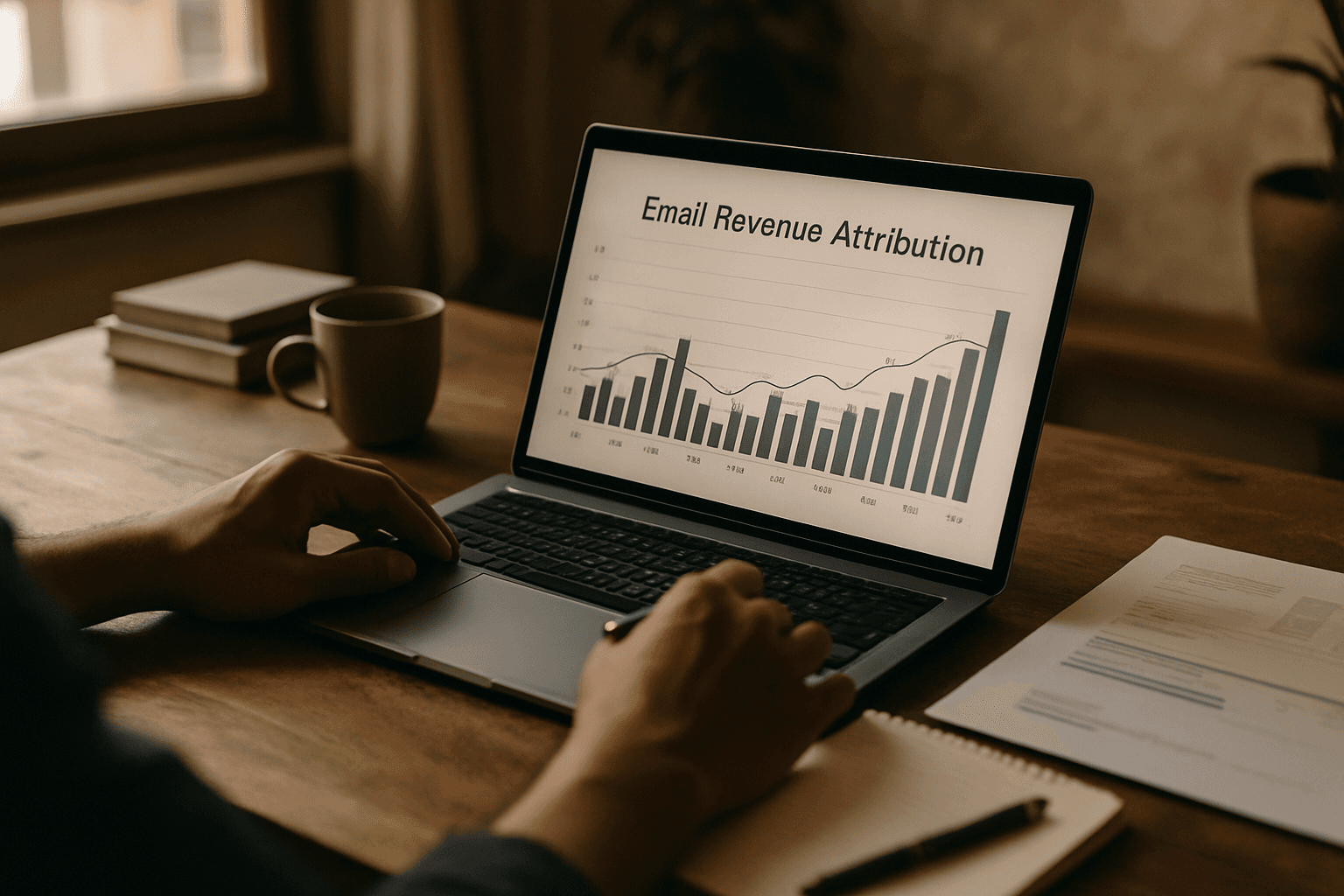
Stop guessing which emails actually drive purchases. Revenue attribution assigns closed-won revenue to specific campaigns and sequences, showing you exactly which messages generate sales. HubSpot defines revenue attribution as analyzing how much closed-won revenue can be attributed to marketing emails, and without this data, you're operating on instinct, not insight.
Track first-touch, last-touch, and multi-touch attribution models to map the full customer journey from first click to checkout. A healthy target is to have 20-25% of total revenue coming from email and SMS marketing combined. Once you see which campaigns actually move revenue, you stop funding the emails that don't. This single metric justifies every dollar you spend on your email program.
RPE divides your total email-generated revenue by the number of emails sent. It's the cleanest answer to: "For every email I send, how much money do I make?" This cuts through the noise of vanity metrics like opens and clicks.
Compare RPE across campaign types, promotional vs. automated vs. newsletter, to find where your real money is made. When RPE starts declining, your list is cooling off or your targeting has slipped. A healthy target is to have 20-25% of total revenue coming from email and SMS marketing combined. Without RPE, you're guessing what's actually paying for your platform fees.
Click-through rate (CTR) measures the percentage of your email subscribers who actually click a link, it's the metric that separates browsers from buyers. For alcohol brands, industry benchmarks land around 2-5%, per Opensend. If your open rates are strong but CTR is low, your subject lines are working but your content or call-to-action isn't.
Revenue per recipient email is the only metric that ties sends to sales. Learn why RPR beats open rate and how to use...
High CTR signals subscribers are engaged enough to take action, not just glance and delete. To optimize CTR, split test button placement, CTA copy, and offer types. Better CTR flows through to your email revenue attribution, it means more conversions and measurable ROI from your list. Pairing email with SMS engagement doubles purchase likelihood, per Attentive, so your email strategy should be part of a multi-channel approach.
Your conversion rate is the number that tells you what actually happened after someone clicked your email. It tracks the percentage of clicks that resulted in a purchase, your real email revenue attribution. No conversion means no revenue, no matter how many opens or clicks you banked.
Compare conversion rates across campaigns, segments, and time periods to find your winners. When your CTR is healthy but conversions tank, the problem isn't your email, it's your landing page, offer urgency, or product selection. A healthy target is to have 20-25% of total revenue coming from email and SMS marketing. Optimize offer urgency, product selection, and page experience to lift this metric.
Hard bounces are permanent failures, invalid addresses that destroy your sender reputation and tank deliverability. Soft bounces are temporary (full inbox, server timeout) but become hard bounces when ignored. Email platforms track three critical delivery metrics: delivery rate, soft bounce rate, and hard bounce rate, per Bloomreach.
When your hard bounce rate climbs, inbox providers flag you as spam. Remove hard bounces immediately to keep your email revenue attribution clean. Maintain an overall bounce rate under 2% and your deliverability stays intact, which protects every other metric feeding your revenue data.
Your delivery rate measures emails that made it past bounces to the recipient's server. But here's the catch: delivered doesn't mean seen. Even emails landing in spam are technically "delivered." Pair your delivery rate with inbox placement data to know if your emails are actually in front of your audience.
Discover the 7 backend optimization mistakes costing DTC brands thousands. Learn email revenue attribution, segmentat...
When delivery drops suddenly, it signals list quality problems or sending issues your ESP is penalizing you for. The algorithm decides your inbox placement based on engagement signals, so if your list is stale or disengaged, your best subject lines and offers never get seen. And when emails don't get seen, your email revenue attribution looks worse than it actually is.
Your unsubscribe rate tells you which subscribers voted with their feet. It measures the percentage of people who opted out per campaign, and when paired with email revenue attribution, it shows you exactly how much future revenue you're losing when contacts flee. Key metrics for email marketing success include open rate, click-through rate, conversion rate, bounce rate, and unsubscribe rate, per Improvado.
Sudden spikes in your unsubscribe rate signal a problem, usually wrong content for wrong segment. Those unsubscribes signal list decay and wasted send volume on disengaged contacts.
Track which email subscribers become your best customers. CLV attribution connects engagement to long-term value, not just first purchases. Segment your list by lifetime value to identify your highest-value email subscribers, then double down on campaigns that keep them buying. Build win-back flows for lapsed top customers. Email should drive repeat purchases, not just first-time conversions.
A healthy target is having 20-25% of total revenue coming from email and SMS marketing, per Drip. If you're only tracking first-purchase attribution, you're leaving your most profitable customers unaddressed, and that's where email revenue attribution changes everything.
If you're not tracking which subscribers engage on both SMS and email, your email revenue attribution is missing half the picture. Subscribers engaged on both channels are 2x more likely to purchase than single-channel subscribers, per Attentive, and they spend more and churn less.
Stop guessing if email is working. Track these 11 metrics to prove email drives 30%+ of your DTC revenue and 36:1 ROI.
Tag everyone who opens, clicks, or texts across both channels in your ESP. Then integrate SMS + email into your highest-revenue flows: abandoned cart recovery, post-purchase sequences, and win-back campaigns. Brands treating SMS and email as separate channels are leaving a multiplier on the table. The ones building unified subscriber profiles are the ones hitting 20-25% of total revenue from these channels combined.
Track this: new subscribers added minus unsubscribes and bounces. If your list is shrinking, your email revenue will decline, it's that simple. Stop chasing vanity numbers. A list of 10,000 unengaged contacts isn't worth 2,500 active buyers.
Grow your list with lead magnets, exit-intent popups, and post-purchase capture, and consider that subscribers engaged on both SMS and email are 2x more likely to purchase than those on only one channel. Growth matters. Quality matters more.
Track what percentage of your total Shopify revenue email and SMS generate each month. According to Drip, a healthy target is to have 20-25% of total revenue coming from email and SMS marketing combined. This metric tells you whether email is a profit driver or a side gig.
If email accounts for less than 15% of your revenue, you're likely over-relying on paid ads, and overpaying for every customer. Brands treating email as a core revenue channel, not a discount blast, consistently outperform peers. Calculate it monthly: divide your email-attributed revenue by total Shopify revenue. If you're below that 20-25% range, your email revenue attribution needs an overhaul, and so does your ad spend strategy.
Stop celebrating opens. Start tracking what pays.
If you're ready to connect your email program to actual revenue numbers, book a free 15-minute strategy call and we'll show you exactly where your email channel stands.